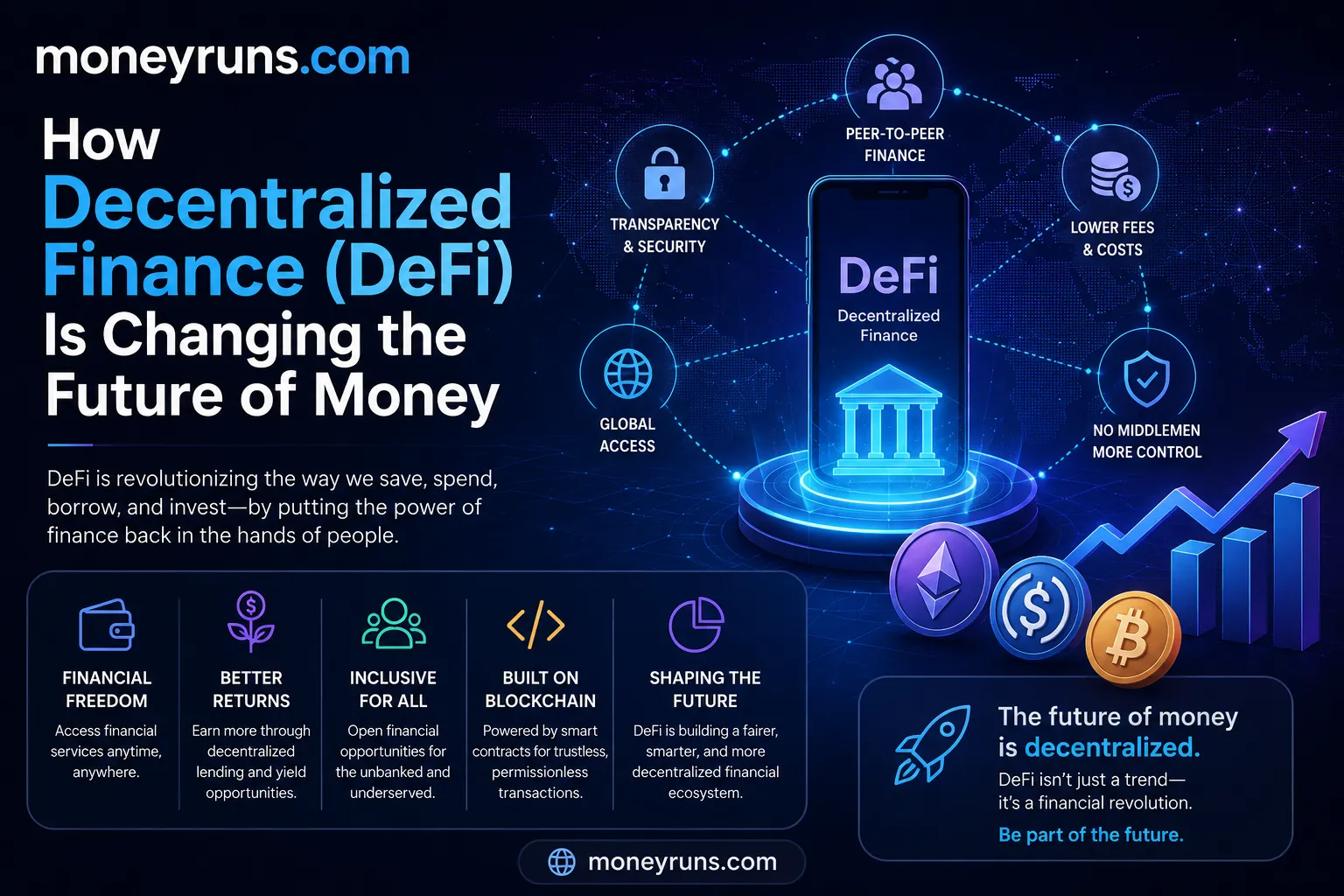
The financial world is undergoing one of the biggest transformations in modern history. Traditional banking systems that once controlled loans, savings, payments, and investments are now facing competition from a rapidly growing digital ecosystem known as DeFi.
DeFi, short for Decentralized Finance, is a blockchain-based financial system that removes intermediaries such as banks and financial institutions. Instead of relying on centralized control, DeFi platforms use smart contracts and blockchain technology to provide financial services directly to users.
Over the past few years, DeFi has become one of the most discussed sectors in cryptocurrency and blockchain technology. Millions of people worldwide are exploring decentralized lending, borrowing, staking, trading, and passive income opportunities.
But while DeFi offers innovation and financial freedom, it also introduces new risks and challenges. Understanding how DeFi works is essential for anyone interested in the future of digital finance.
What Is DeFi?
DeFi refers to financial applications built on blockchain networks, primarily Ethereum and other smart contract platforms.
Traditional finance depends on centralized institutions such as:
- Banks
- Payment processors
- Insurance companies
- Brokers
- Governments
DeFi removes these middlemen and replaces them with automated smart contracts.
Smart contracts are self-executing programs stored on blockchains. These programs automatically perform transactions when specific conditions are met.
This allows users to access financial services directly from digital wallets without requiring approval from centralized authorities.
How DeFi Works
DeFi applications operate through decentralized protocols.
Users connect crypto wallets to DeFi platforms and interact directly with blockchain systems.
For example, someone can:
- Lend cryptocurrency
- Borrow funds
- Earn interest
- Trade assets
- Provide liquidity
- Buy decentralized assets
all without opening a bank account.
Transactions are verified by blockchain networks instead of traditional financial institutions.
This creates a financial ecosystem that operates 24/7 globally.
The Role of Smart Contracts
Smart contracts are the foundation of DeFi.
These automated contracts eliminate the need for manual processing and third-party control.
For example, in traditional banking:
- Loan approvals require paperwork
- Banks verify identities
- Transactions may take days
In DeFi, smart contracts automatically handle these operations within minutes.
This increases speed, efficiency, and transparency.
However, smart contracts must be carefully coded because bugs or vulnerabilities can lead to financial losses.
Popular DeFi Services
DeFi is much larger than simple cryptocurrency trading. It includes multiple financial sectors.
1. Decentralized Lending
DeFi lending platforms allow users to lend cryptocurrency and earn interest.
Borrowers can access funds without traditional credit checks.
Everything operates through blockchain-based collateral systems.
This creates opportunities for people who may not have access to traditional banking services.
2. Decentralized Exchanges (DEXs)
Traditional crypto exchanges rely on centralized companies to manage trading.
DeFi introduced decentralized exchanges where users trade directly from their wallets.
Benefits include:
- Greater privacy
- No centralized control
- Faster accessibility
- Global participation
DEXs have become extremely popular in the crypto industry.
3. Yield Farming
Yield farming allows users to earn rewards by providing liquidity to DeFi protocols.
Investors deposit crypto assets into liquidity pools and receive returns in exchange.
Some yield farming opportunities offer high rewards, but they also involve significant risk.
4. Staking
Staking allows users to lock cryptocurrency in blockchain networks to support operations and earn rewards.
It is considered one of the simpler forms of passive income in the crypto ecosystem.
5. Stablecoins
Stablecoins are cryptocurrencies linked to stable assets such as the US dollar.
They reduce volatility while allowing users to remain within blockchain ecosystems.
Stablecoins play a major role in DeFi transactions and lending systems.
Why DeFi Is Growing Rapidly
Several factors are driving DeFi adoption globally.
Financial Accessibility
Millions of people worldwide remain unbanked or underbanked.
DeFi allows anyone with internet access and a crypto wallet to participate in financial services.
Transparency
Blockchain transactions are publicly recorded, increasing visibility and reducing hidden manipulation.
Lower Fees
Traditional financial systems often involve multiple intermediaries and expensive fees.
DeFi reduces many of these costs through automation.
Global Availability
DeFi platforms operate internationally without geographic restrictions.
This creates equal access for users from different countries.
Risks and Challenges in DeFi
Despite its innovation, DeFi is not risk-free.
Smart Contract Vulnerabilities
Coding errors in smart contracts can lead to hacks and stolen funds.
Several DeFi projects have experienced massive financial losses due to security flaws.
Market Volatility
Cryptocurrency prices can change rapidly.
This volatility affects DeFi lending, borrowing, and investment returns.
Rug Pull Scams
Some fraudulent projects attract investors before suddenly disappearing with user funds.
This remains a major issue in the crypto industry.
Regulatory Uncertainty
Governments worldwide are still developing rules for decentralized finance.
Future regulations may significantly impact DeFi platforms.
Impermanent Loss
Liquidity providers can experience losses due to changing token prices.
Many beginners underestimate this risk.
The Importance of Wallet Security in DeFi
Because DeFi platforms are decentralized, users maintain full control over their funds.
This also means users are fully responsible for their security.
Protecting crypto wallets is extremely important when using DeFi services.
Important security practices include:
- Using hardware wallets
- Avoiding suspicious websites
- Protecting recovery phrases
- Verifying smart contracts
- Enabling multi-layer security
Unlike traditional banks, there is usually no customer support team that can recover lost assets.
DeFi and Financial Freedom
One of the biggest attractions of DeFi is financial independence.
Users no longer need permission from banks or institutions to:
- Send money globally
- Earn interest
- Access loans
- Trade assets
- Participate in investments
This shift represents a major philosophical change in how people interact with money.
Many supporters believe DeFi could reduce dependence on centralized financial systems in the future.
The Role of Ethereum and Blockchain Networks
Ethereum played a major role in launching the DeFi movement because of its smart contract capabilities.
However, other blockchain networks are also entering the space, including:
- Solana
- Avalanche
- BNB Chain
- Polygon
- Cardano
Competition between blockchains is driving innovation, lower transaction costs, and faster speeds.
Institutional Interest in DeFi
Initially, DeFi was dominated by individual crypto users.
Today, institutional investors and financial companies are also exploring decentralized finance.
Large firms are researching:
- Tokenized assets
- Blockchain settlement systems
- Decentralized lending
- Digital identity verification
This growing institutional involvement may increase mainstream adoption in the coming years.
The Future of DeFi
The future of DeFi appears highly promising but also uncertain.
Possible future developments include:
- AI-powered decentralized finance
- Cross-chain interoperability
- Faster blockchain networks
- Improved security systems
- Government-regulated DeFi services
- Real-world asset tokenization
As technology evolves, DeFi could reshape global banking, investing, and financial infrastructure.
However, widespread adoption will depend heavily on security, regulation, scalability, and user education.
Why Education Matters in DeFi
Many people enter DeFi chasing quick profits without understanding the risks.
This often leads to costly mistakes.
Successful DeFi participation requires knowledge about:
- Blockchain technology
- Smart contracts
- Wallet security
- Market risks
- Liquidity systems
- Crypto economics
Education remains one of the most valuable tools in decentralized finance.
Conclusion
DeFi is more than just a crypto trend. It represents a new financial system built around transparency, automation, accessibility, and decentralization.
By removing intermediaries and giving users direct control over their assets, DeFi has opened opportunities that traditional banking systems could never fully provide.
At the same time, DeFi introduces serious responsibilities and risks. Security, research, and financial education are essential for navigating this rapidly evolving space.
As blockchain technology continues improving, decentralized finance may become one of the most important innovations in global financial history. Whether DeFi completely replaces traditional finance or works alongside it, its impact on the future of money is already undeniable.